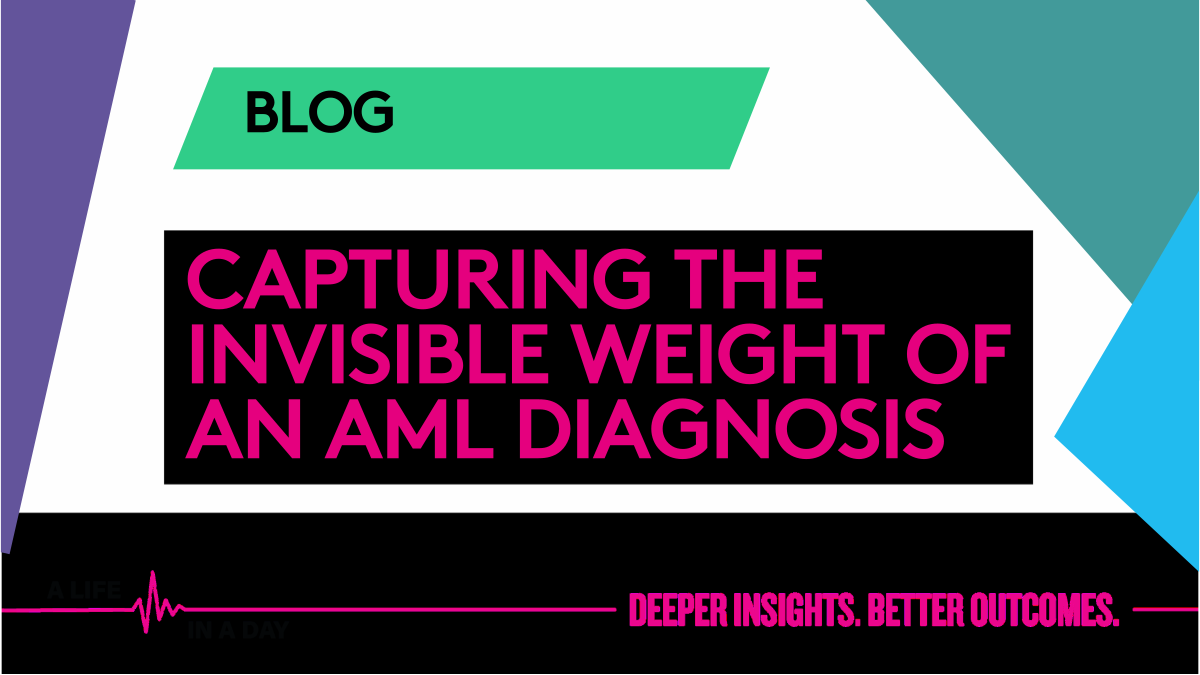
Senior Creative Lead, Chloe Kent, shares her experiences in creating one of our latest experiences exploring the stories and challenges shared by those living with Acute myeloid leukaemia .
Acute myeloid leukaemia is the first oncology experience I’ve developed at A Life in a Day, and one of the most serious diagnoses I’ve ever come across. Acute leukaemia progresses very quickly, and AML can become deadly within weeks without aggressive treatment.
To treat the disease, patients undergo chemotherapy so intensive that they must be admitted to hospital for weeks on end following each round. This isn’t just to manage the side effects, although these can obviously be extreme. By design, chemotherapy for acute myeloid leukaemia effectively wipes out the patient’s bone marrow entirely, leaving them temporarily without any immune protection and extremely vulnerable to infection.
For patients, this situation is of course devastating. Alongside the physical trauma of being so seriously unwell, they are confined to a specialist hospital room, often alone, unable to leave unless they’re being taken for tests and treatment.
For an A Life in a Day experience, this presents an interesting challenge. Our programmes are designed to be delivered via a mobile app, a physical kit of items, and role-play calls, all within the flow of a working day. But with AML, I knew we needed to capture, not just the clinical reality of treatment, but the emotional and psychological weight of it too.
Plenty of our programmes include moments of hospital care, but AML called for something different. This was a chance to explore a dimension of patient experience that is rarely visible from the outside, and to think carefully about how to help participants feel its impact in a way that is both meaningful and memorable.
From the point participants receive their diagnosis, the experience takes on a very different tone. The world becomes smaller, routines shift, and everyday freedoms begin to feel less certain. Rather than spelling out every mechanism we use to create that shift, I’m more interested in what it allows people to notice: how quickly life can narrow, how isolating treatment can feel, and how much resilience can be required simply to get through each day.
That change in perspective is where the experience really begins to do its work. It’s not about replicating every practical detail. It’s about creating just enough of a shift that participants start to feel the tension between what the outside world expects and what a patient may actually be carrying. That space, between the visible and the invisible, is where empathy starts to deepen.
By the end, participants have had only a brief glimpse of what it might mean for your world to contract so suddenly and so completely. Even in that short time, the effect can be striking. Daily habits look different. Assumptions fall away. And the patient experience can start to feel a little less abstract, a little more human, and much harder to forget.
If participants finish the day with a deeper understanding of what intensive treatment might feel like, if they pause a little longer when thinking about the patient behind the pathology, then the experience has done what it set out to do. And if it leaves them curious about how we approached something as complex as AML, even better.
Because at the heart of this programme, as with every A Life in a Day experience, is a simple aim: to bring people closer to the human reality of disease and, in doing so, to foster ongoing understanding and empathy long after the training ends.