

Patient centricity is dead. Or at least that’s what some industry thought leaders believe regarding the term “patient centricity”. Whether it’s simply being over-used, or the phrase has started to lose its meaning through various interpretations, many within pharma are looking for other terminology to help demonstrate their passion and ongoing commitment to the patient.
An increasingly popular definition that has emerged is a patient-integrated approach. It still puts the patient first, even literally, but it doesn’t necessarily have the same implications as patient centricity. Adopting a fully patient-integrated approach takes patient centricity one step further with a longer-term strategy focus, increased buy-in from departments beyond the apparent, and patients metaphorically working as an equal at the decision-making table.
Patient-centred vs. patient-integrated – does it matter?
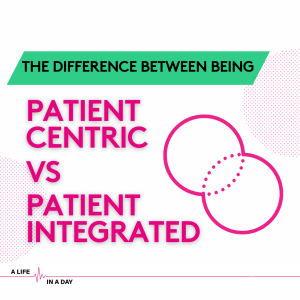
Absolutely! We’ve loved being a part of the industry’s patient-centred journey and have seen the commitment to this increasing dramatically in the last couple of years. What we’re now starting to see however, is companies taking their patient centricity goals one step further and making and developing a truly patient-integrated strategy. There are two key ways in which they are doing this:
1. Walking the patient walk, as well as talking the talk
Every single participant in one of our experiences always summarises their thoughts with a phrase like “I will never forget this” and/or “I will always think about the patient moving forward.” This self-evaluation is great, and a necessary foundation for true patient centricity. However, alongside having a strong patient mindset, we are now challenging participants to not just think about the patient, but to come up with at least one tangible action or change they can undertake to change their role for the benefit of the patients they serve. Alongside thinking about the patient, they are acting for the patient and improving outcomes for themselves, the companies they work for and, most importantly, the patient.
2. Expanding patient activities throughout the company and beyond
We’ve worked extensively with commercial teams showcasing the industry need to incorporate the patient experience into their strategies. At the end of the drug development process and the face of the business, it’s evident why commercial teams would benefit from a patient centric approach. What we’ve evaluated however is that the tangible benefits of a patient-integrated strategy are achieved by expanding these efforts throughout the drug development process. By exposing all functions involved in the process, and even beyond product launch, the patient voice is amplified and considered throughout all business activities.
Clinical trial teams are working with us to understand what their participants go through to better the experience for them and in return receive improved data results. Medical Affairs teams are taking part to help develop their team’s understanding of their patient’s journey to advance KOL engagement and strengthen HCP relationships. All teams throughout pharma are ensuring that the patient is not just a dataset, but an equal voice that is included every step of the way.
The evolution from centricity to integration doesn’t diminish the importance of patient centricity – it strengthens it. Together, these approaches ensure that patients remain at the heart of healthcare, driving progress and innovation that truly makes a difference. Whether it’s through small, tangible actions or organisation-wide transformations, the commitment to bettering patients’ lives remains the unifying force across the healthcare industry.